
Still Life In Places 2026
Online Exhibition
This exhibition presents Still Life in Places as a complete body of work.
Each painting reflects a moment, a place, or a memory—developed slowly through observation, revision, and quiet reflection.
The series unfolds as a visual narrative, where individual works stand alone while contributing to a larger sense of time, presence, and lived experience.
Hello friends,
Welcome, I will be sharing a body of work titled
Still Life in Places
Some of you have already seen a few of these paintings over the past months. Your responses have truly humbled me—more than I can express.
This series is not about fortune or fame. It is about telling the story of a life—my life—and perhaps, in some small way, connecting with yours.
I don’t claim to be the greatest artist. There are countless painters who can outpaint me any day. But what I offer is something different—
these works are rooted in lived experience. Each painting carries a moment, a place, a memory… and a lesson.
Life is a series of choices. And if we live long enough, we begin to reflect on those choices—some we celebrate, others we question.
As I approach sixty, I find I have only one true regret: that I did not place Jesus Christ at the center of my life sooner.
I always believed in God. But belief alone is not the same as faith. Faith asks us to trust in what we cannot see or touch—and that can be difficult.
Yet I stand here today because, in the darkest moment of my life, I experienced God’s saving grace.
Some have said I am crazy. That chaos follows me.
But if experiencing the miracles of Christ makes me crazy, then I accept that gladly.
And as for chaos—it does not follow me. It exists in this world already. We are simply living in it.
For those of us who believe, we are not here by accident. We are here because we are called to endure, to love, and to stand firm.
“The Lord is my light and my salvation—whom shall I fear?
The Lord is the stronghold of my life—of whom shall I be afraid?”
— Psalm 27:1
These paintings are, in the end, just paintings. A gift from God, yes—but the deeper truth lies in how they came to be.
They are shaped by the people I have loved, the friendships I have known, and the journey I continue to walk.
I invite you to follow along, to reflect, and to share in this story—
a story of joy, love, and faith… in the midst of the storm.
If this resonates with you, I would be grateful if you shared it. Even a visit helps bring this work into the world.
With love and peace,
Gene Edward Stout
This painting begins in stillness—shared time, quiet companionship, and the unnoticed rituals that define a relationship.
During long evenings spent together, we watched Frasier from beginning to end. What began as background became something more intimate. I found myself drawn not only to the characters, but to the subtle, ever-changing floral arrangements on the set—small, deliberate shifts that mirrored the quiet evolution of our own time together.
The daisies became a symbol of that connection. “Daisy” was the name I often used for her—an expression of affection, light, and familiarity. The reference to winter reflects both a place and a state: New Hampshire, and the emotional stillness that would later reveal itself.
This piece holds a moment before fracture—a memory preserved in calm observation, where beauty exists without yet knowing its impermanence.
“Daisy’s In Winter” (Frasier)
• 11 x 14 Inches
• Watercolor - watercolor ground
• Archival Paper
This work emerges from longing—not for a place alone, but for emotional distance from what had become inescapable.
Composed from multiple drawings brought together into a single image, the painting reflects a fragmented internal landscape. The idea of Tuscany—sunlit, distant, serene—became a mental refuge. Not a literal destination, but a constructed space where peace could exist beyond present circumstances.
Color becomes the language of conflict. Deep reds and greens press against one another, refusing harmony. They embody the tension between desire and reality—the pull to escape and the weight of what remains unresolved.
This is not a painting of travel, but of the need to leave without moving. A meditation on the human instinct to seek relief from emotional confinement, and the realization that such escape is often internal, not geographic.
“Dreaming Tuscany”
• 16 x 20 Inches
• Watercolor
• Archival Paper
This painting marks a transition—both physical and psychological.
After relocating to Delaware, a shift occurred that was visible to others before it was fully understood within. There was restlessness, heightened energy, and an underlying instability that moved quietly beneath the surface. What appeared outwardly calm was, in truth, the edge of collapse.
The work reflects this duality. Areas of the composition seem drained of color, while others retain a quiet beauty. This contrast speaks to a fragmented self—one part unraveling, another still searching for meaning and dignity within that unraveling.
At its core, the painting confronts a difficult question: what remains when identity begins to fracture? Beneath the anxiety and disorientation, there is an awareness—however faint—that something more still exists, waiting to be seen.
“The Three Mornings”
• 11 x 14 Inches
• Watercolor
• Archival Paper
This piece revisits a past gesture of love, reinterpreted through the lens of loss.
Originally painted in oil and given as a gift to my wife, the image carried meaning that extended beyond the object itself. Returning to it in watercolor required a deliberate pause—an understanding that revisiting the subject would reopen something unresolved.
The process became emotional terrain. Memory, grief, and hope coexisted within the act of painting. At the time, communication still remained, and with it, the possibility—however uncertain—of reconciliation.
This work holds that tension: the persistence of love after separation, and the difficulty of accepting its transformation. It reflects a moment suspended between belief and reality—where faith suggests restoration, but experience begins to suggest otherwise.
“Hearts & Berries”
• 16 7/8” x 16 7/8 Inches
• Watercolor -Colored Graphite
• Archival Paper
This painting returns to a place of origin—both in memory and in meaning.
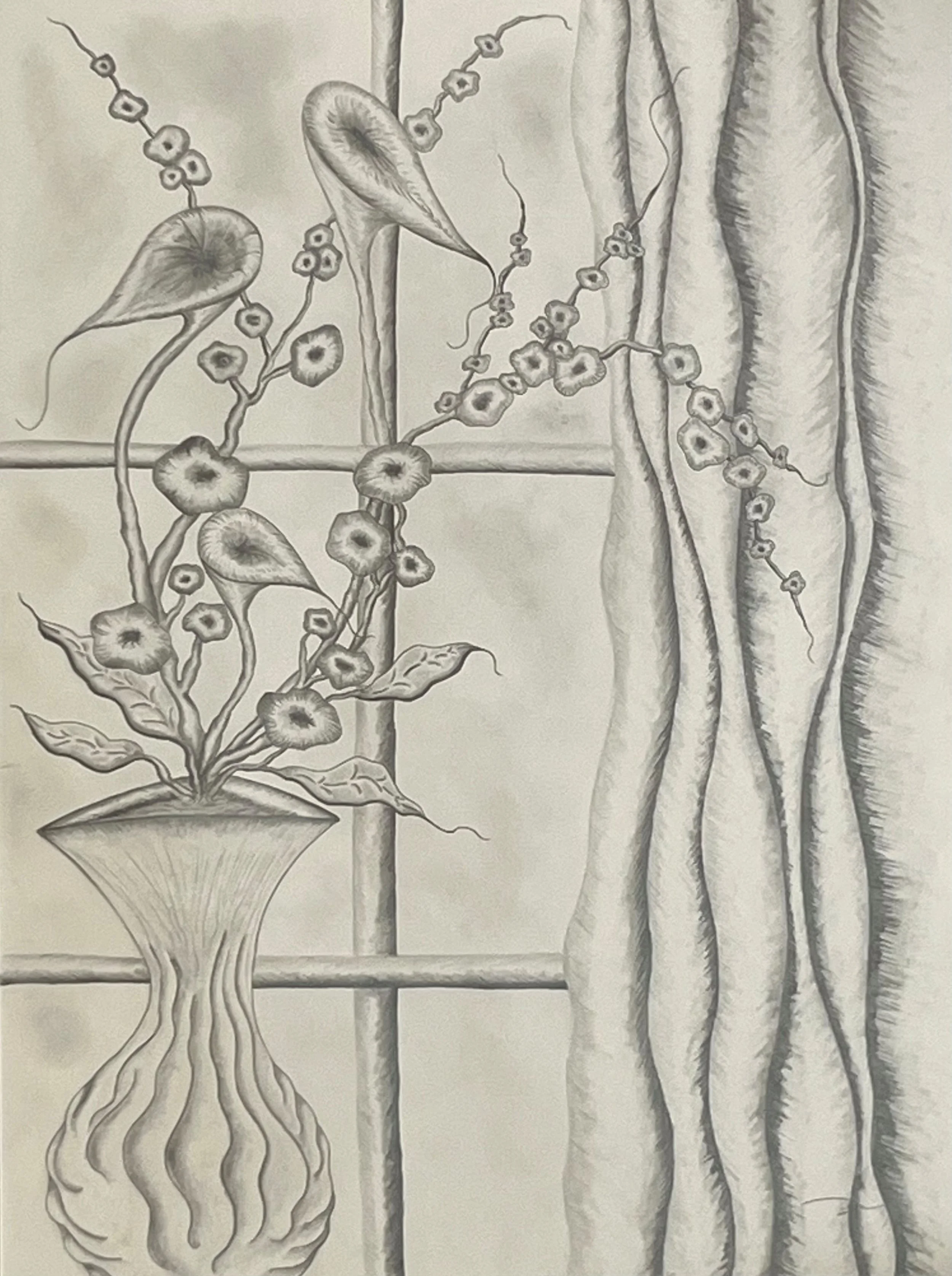
The view is drawn from a window in Lake Sunapee, where mornings began with light entering the room and quietly defining the day. The space itself was simple, but it held a sense of beginning—of routine, of shared life, of presence.
The vase, though empty in reality, is imagined as full. This act of imagining becomes central: the mind completing what the physical world does not provide. It is a gesture of hope, of projection, and of belief in what could be.
This work also marks a shift in authorship. Where earlier works were described through personal agency—I made this—there is now a recognition of something beyond the self. A surrender of control, and an acceptance of guidance shaped by faith.
The painting becomes not only a memory of place, but a statement of transformation—where loss, love, and belief converge into a shared act of creation.
“Lake Sunapee”
• 18 × 24 Inches
• Watercolor
• Archival Paper
This work returns to a moment of quiet effort—an attempt to hold something together that was already beginning to shift.
Created during a drawing session at the New Hampshire Library Arts Center, the painting reflects a time when reconciliation still felt possible. The space itself was familiar; it had previously held my work, offering a sense of validation and belonging. Yet beneath that surface was a growing disconnect.
Looking back, there is a recognition of how narrowly I was seeing things—viewing the relationship through an idealized lens, unable to fully perceive the strain that was building. What felt stable was, in truth, fragile.
This piece captures that unawareness. It exists in the space between hope and recognition—before the weight of what was coming had fully revealed itself.
“Library Arts Session” v1
• 11 x 14 Inches
• Watercolor - watercolor ground
• Archival Paper
This painting emerges from a period of profound physical and emotional collapse.
Following a near-fatal automobile accident, my life was unexpectedly spared. What followed was not relief, but disorientation—an unstable movement between clarity and confusion, compounded by severe physical injury and the unraveling of my marriage.
The separation that followed was not sudden, but necessary. What remained was a prolonged period of depression, where connection to family, to purpose, and to creative work felt increasingly distant.
Painting became difficult—nearly inaccessible. When it returned, it did so through restraint. The monochromatic blue palette is a direct acknowledgment of that emotional state, referencing the tradition of artists who have used color as a language of loss.
This work is not expressive in the traditional sense—it is contained, subdued. It reflects a period where feeling existed, but expression struggled to find form.
“Library Arts Session” v2
• 11 x 14 Inches
• Watercolor
• Archival Paper
This piece revisits a moment of attempted renewal—when separation gave way briefly to reconciliation.
Set within the landscape of Mount Sunapee, the work blends observation with surreal distortion. Influences from surrealism emerge not as imitation, but as a means of expressing instability beneath the surface. Forms stretch, balance shifts, and familiar structures become uncertain.
There are underlying tensions within the composition—suggestions of desire, imbalance, and emotional weight. Elements that appear stable are subtly burdened, hinting at the fragility of what is being rebuilt.
At the same time, there are gestures toward growth. The presence of softer forms and emerging color reflects a desire for something more grounded, more enduring—beyond surface connection.
This painting exists in a state of contradiction: hope present, but not yet secure; connection restored, but not yet stable.
“Mt. Sunapee Surreal”
• 16 x 20 Inches
• Watercolor - Colored Graphite
• Archival Paper
“Myself In Delaware”
• 18 x 24 Inches
• Watercolor - watercolor ground
• Archival Paper
This work turns inward—an abstracted self-portrait formed through symbol rather than likeness.
The initial image began as an experiment, incorporating variations of earlier drawings. What emerged, however, revealed something unexpected—an image that carried more weight than its origin suggested. It presented itself not as a constructed idea, but as something already understood, waiting to be recognized.
In refining the piece, elements were intentionally stripped back. What remained was essential: the vessel, the branch, and the fruit. Together, they form a quiet but direct language.
The fruit takes on the role of connection—representing relationships, presence, and the people who exist within one’s life. They appear full, luminous, and complete, suggesting the richness of those bonds.
The branch, however, stands apart. It extends outward, reaching, yet never fully integrating with what surrounds it. It carries the fruit, but does not seem sustained by it. There is a separation—subtle, but undeniable.
In this, the branch becomes a reflection of the self.
It suggests a state of isolation—not in the absence of others, but in the inability to fully connect. A condition of being present, yet removed. Supported in appearance, but internally detached.
The surrounding space reinforces this distance. The blue field, expansive and quiet, holds both calm and weight. It suggests reflection, but also emotional depth—an environment where clarity and solitude coexist.
Yet this work is not without hope.
There is strength in the structure of the branch. Despite its separation, it continues to reach. It does not collapse inward. It remains extended, searching, alive.
This painting marks a moment of recognition.
Not of resolution—but of truth.
Still Life In Places 2026
Online Exhibition
The first half of this series reflects a period shaped by endurance, transition, and quiet persistence. These works carry the weight of lived experience—moments of uncertainty, rebuilding, and reflection that unfolded slowly over time. What began as observation gradually became something more personal, as each composition absorbed fragments of memory and internal change.
As the series progresses, a sense of clarity begins to emerge. Form becomes more intentional, and the work settles into a quieter confidence—less searching, more understanding. What remains is not only what was seen, but what was lived and shaped through time, reflection, and a steady return to presence.
In Quirky Pot v1, I began exploring the sensation of fire—not as destruction, but as an internal force. A fire that burns quietly and loudly at once. A presence that cannot be ignored, yet is often misunderstood.
The composition reflects this tension. The floating forms and branching stems move outward in an almost explosive rhythm, while cooler tones beneath suggest a steady, controlled burn. The energy is both chaotic and contained.
The pot itself represents the ordinary—the grounded, familiar vessel that holds something far more alive than it appears. Around it, the table, drapery, and fruit act as quiet distractions. They exist as reminders of how easily we are drawn away from what matters most.
At its core, this piece is about attention—about resisting distraction and returning to the inner flame. A flame that is both personal and spiritual, and ultimately, divine.
“Quirky Pot” v1
• 11 x 14 Inches
• Watercolor
• Archival Paper
This work revisits the same emotional terrain as Quirky Pot v1, but with a more deliberate focus on balance and relationship.
Rather than centering on a single internal force, this painting explores duality—how two energies can exist in tension while remaining connected. The composition is structured around this idea, with color acting as the primary language. Blues and purples shift across the surface, at times converging, at times pulling apart.
The surrounding elements are intentionally understated. They exist, but do not demand attention. What matters is the relationship between the focal forms—how they interact, how they hold space, and how they remain distinct.
The objects themselves resist fixed definition. Their identity is less important than their role within the composition. This ambiguity allows the painting to move beyond representation and into something more experiential.
At its core, this piece is about coexistence—about learning to hold contrast without needing to resolve it.
“Quirky Pot” v2
• 11 x 14 Inches
• Watercolor - watercolor ground
• Archival Paper
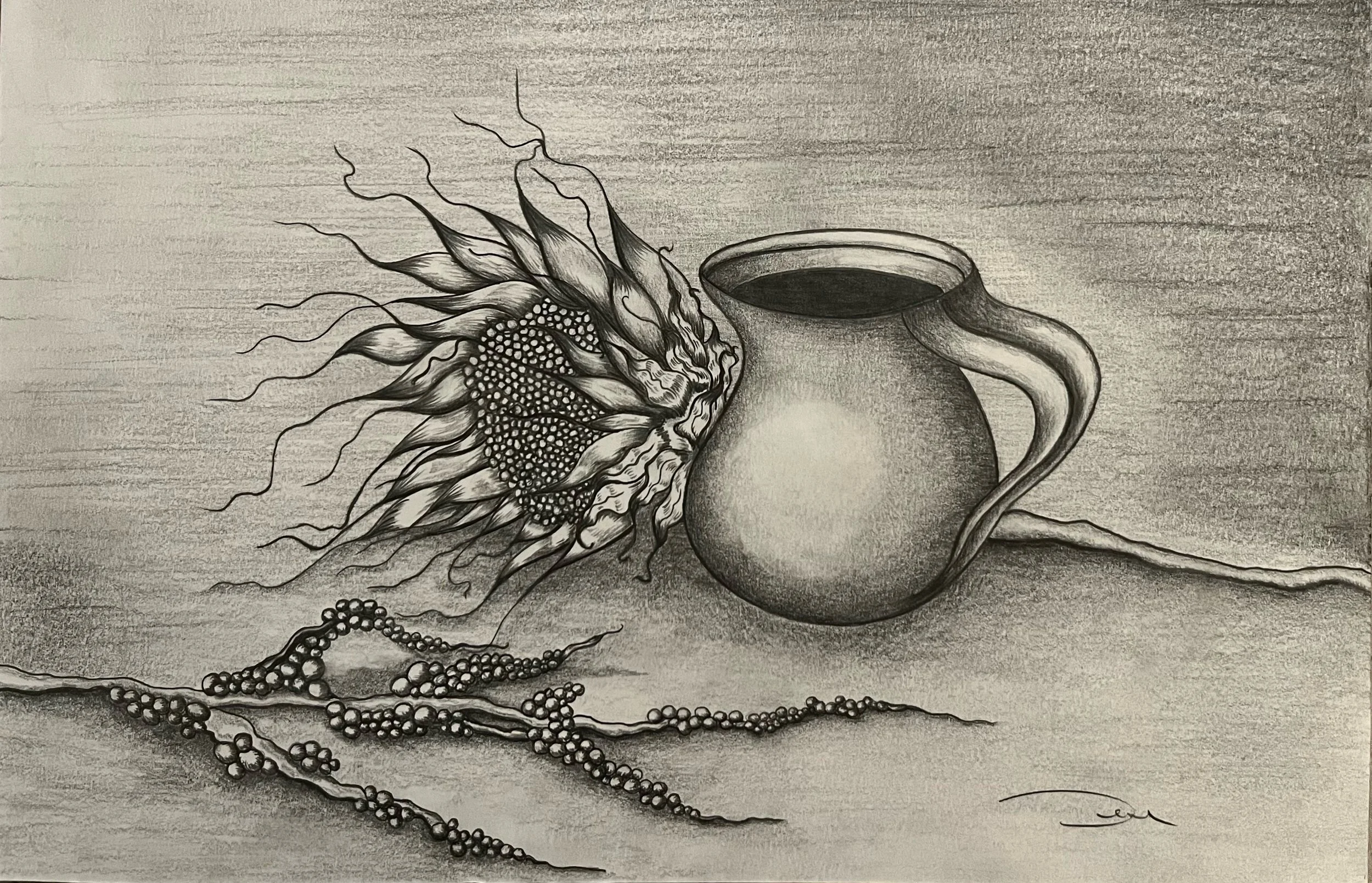
This painting originates from a photograph shared with me during a time when reconciliation was possible.
The image—a cup and sunflowers—became more than a reference. It held the weight of how we understood our relationship: fast-moving, full of energy, and charged with promise. There was a belief that we were building something meaningful together, something that could sustain itself despite its intensity.
In translating that image into paint, I found myself responding not just to what I saw, but to what I felt. The sunflower leans into the cup with a sense of urgency—drawn forward, almost unable to resist. The gesture carries both devotion and imbalance, suggesting a connection that is deeply felt but difficult to sustain.
The cup remains steady. It holds its form, receiving what presses into it, yet unchanged by the force of that contact.
In the foreground, a branch of blueberries extends outward—separate from the central interaction. It introduces another layer to the narrative: continuity beyond the immediate relationship. The berries suggest something that grows more slowly, more deliberately. They speak to connections that are not defined by intensity alone, but by endurance, distance, and time.
The phrase “Today, our day full of promise” once accompanied this image. In retrospect, the painting holds that promise gently—acknowledging both its sincerity and its impermanence.
What remains is not loss alone, but gratitude—for having experienced a love strong enough to create something lasting, even if the relationship itself could not.
“Sunflower Coffee Cup”
• 18 × 24 Inches
• Watercolor - watercolor ground
• Archival Paper
This piece emerges from a period of recovery—both physical and emotional.
Created during therapy in Delaware, the painting reflects a gradual return to connection. Not through force, but through patience. The composition is open, allowing space to exist between forms. That space is not empty—it is active, necessary.
Color becomes a vehicle for healing. Softer tones replace the intensity of earlier works, suggesting a shift toward acceptance and renewal.
This is also a moment where faith re-enters the narrative—not as certainty, but as support. A quiet structure that allows movement forward, even when clarity is incomplete.
The work acknowledges the presence of others—those who offered support, guidance, and care during this time. It is not a solitary piece, even if it appears still.
It is about distance, but also about connection—about what exists between people, and what can grow there.
“The Space Between Us”
• 9 × 12 Inches
• Watercolor - watercolor ground
• Archival Paper
This painting marks a return.
After an extended period away from painting, this work represents a re-engagement with both process and expression. There is a noticeable shift in energy—color becomes more assertive, composition more playful.
The timing is significant. Created during the holiday season, the work carries a sense of warmth and reintroduction to joy. Not as something fully restored, but as something being rediscovered.
There is also an openness to experimentation. New materials, new methods, and new ways of translating earlier ideas into present form are explored here. The process itself becomes part of the meaning.
This piece does not dwell on what was lost. Instead, it acknowledges what remains possible.
“Tilted Yellow Pot”
• 14 × 17 Inches
• Watercolor - watercolor ground
• Archival Paper
This work brings the series into a place of openness.
The vessel, once closed and protective, is now exposed—structured, but no longer guarded. It becomes a representation of self not as something to defend, but as something to share.
The interior is visible. There is no attempt to conceal what exists within.
From this openness, growth emerges. The branching forms extend outward with energy and variation, suggesting a life that is no longer contained, but expressed freely.
There is a sense of movement here—of identity not as fixed, but evolving. The structure remains, but it adapts. It allows for expansion.
This painting is not about resolution. It is about willingness—the decision to remain open, even after fracture.
“Willingly Vulnerable”
• 12 × 15 Inches
• Watercolor - Ink - Colored Graphite
• Archival Paper
This work brings the series to a point of transition.
Across these paintings, I have traced a movement through fracture, reflection, surrender, and renewal. The Turning gathers those experiences into a single moment—not as a conclusion, but as a shift in direction.
The forms remain simple, but the connection between them is essential. What once felt separate is now understood as part of a continuous path. The line that links them carries the weight of experience—everything that has been endured, questioned, and accepted.
This piece is rooted in faith. Not as certainty, but as trust. A belief that transformation holds purpose, even when its meaning is not fully clear.
I do not see this as an ending. It is a threshold—where one story closes, and another begins.
“The Turning”
• 14 × 17 Inches
• Watercolor - Colored Graphite
• Archival Paper
This painting reflects a realization that came quietly, without intention.
What began as a simple drawing evolved into something more revealing—two forms, distinct yet inseparably connected. Growth moves between them, not confined to one or the other, but shared.
The connection is not rigid. It bends, extends, and adapts, suggesting a relationship that is alive—shaped by time, experience, and proximity.
Here, the forms themselves have changed. They are no longer empty vessels, but grounded structures—stable, defined, and self-contained. What grows between them does not originate from dependence, but from what each already is.
At one time, this is how I understood my life with my wife: not as two separate paths, but as something intertwined. A shared structure that strengthened through connection.
Yet within the image, there are quiet signs of change. The movement of the branches is uneven, extending in different directions. Small fragments fall away, suggesting that not everything is held, and not everything remains.
Looking back, the image holds both truth and complexity. It acknowledges the beauty of that bond, while also recognizing that connection alone does not determine permanence.
“Bound in Bloom”
• 16 × 20 Inches
• Watercolor - watercolor ground white and pearl - colored graphite
• Archival Paper
This work was created in a moment of remembrance.
Drawn on the anniversary of my mother’s passing, the image carries a quiet weight. Lilies gather within a golden vessel—held in suspension, neither fully at rest nor in motion. There is beauty here, though it does not arrive without tension.
The setting suggests a search for peace—for stability, for grounding. Yet beneath that stillness, something begins to shift.
From within the arrangement, a form rises. Elongated, reaching, it introduces the presence of transformation—of life continuing beyond what has been lost. What once felt contained begins to open.
This moment turns toward faith—not as conclusion, but as return. A quiet movement toward spiritual rebirth, and toward something greater than personal experience.
Peace is not fully held here—but it is present.
And so is love.
“ Where I Pause ”
• 14 × 17 Inches
• Watercolor - Colored Graphite
• Archival Paper
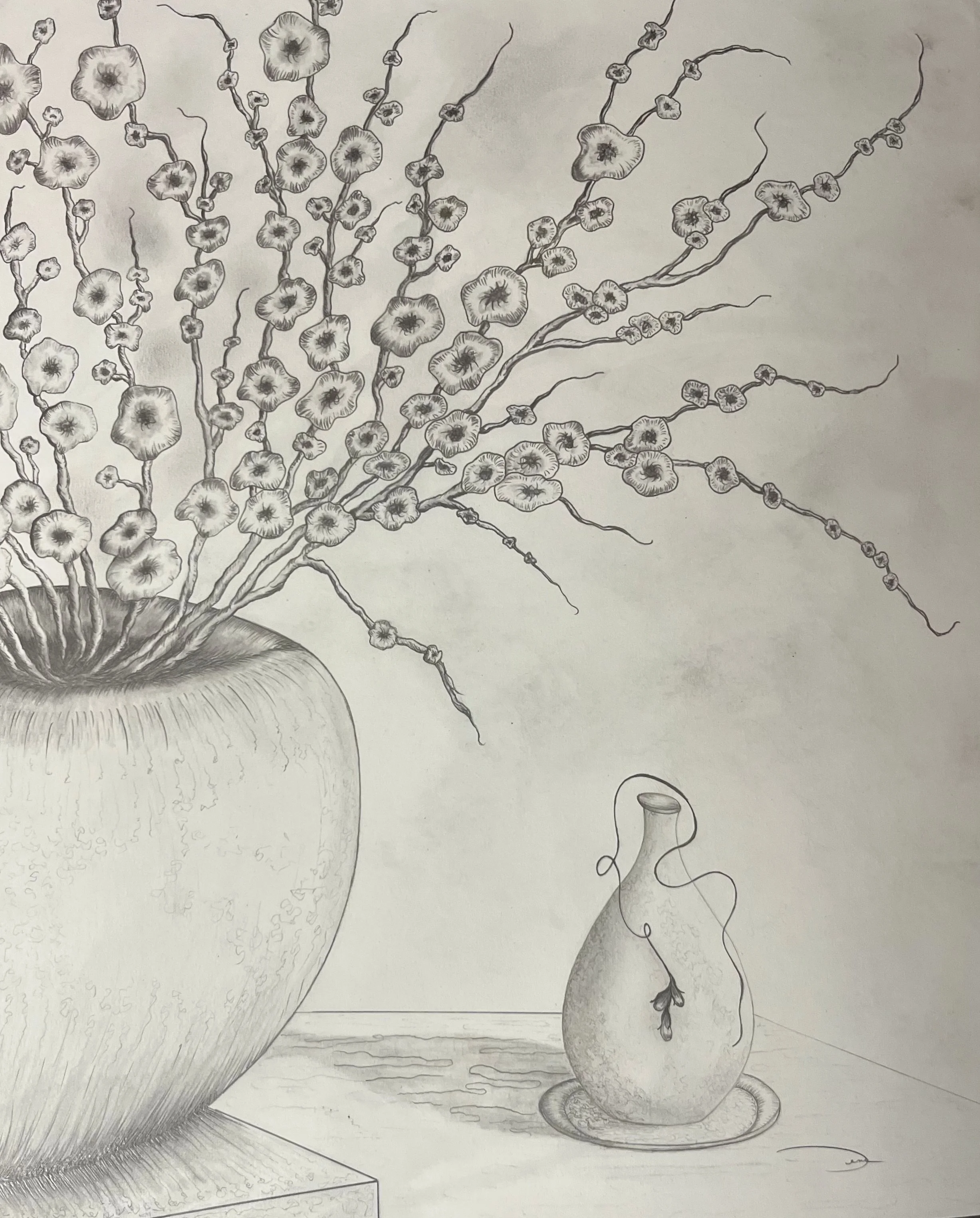
This work brings the series to its present moment.
The vessel remains grounded—stable, centered, and intact. From it extends a single branch, reaching outward into open space. It does not return. It does not resolve. It simply continues.
The flowers remain close to the source, held near the opening of the vessel. They suggest what has already been realized—moments of clarity, connection, and growth that are now understood and carried forward.
The branch, however, moves in another direction. It stretches into distance, into uncertainty, into what has not yet been formed. It becomes a gesture of continuation—of searching, of becoming.
There is tension here between what is known and what lies ahead. Between what has been gathered and what is still unfolding.
Yet the movement is not hesitant.
It is deliberate.
This painting reflects a life no longer defined by what has been lost, but guided by what is being sought.
It does not attempt to complete the journey.
It honors the decision to continue it.
The path ahead is not fully seen—but it is no longer walked alone.
“From Here To There”
• 14 × 17 Inches
• Watercolor - Colored Graphite
• Archival Paper
Still Life In Places 2026
Exhibition Closing
What remains at the end of this series is not simply change, but a return—to faith, to truth, and to a deeper understanding of love.
Through loss, confusion, and survival, I came to recognize that my life was never mine to hold together alone. It was through the grace of Jesus Christ that I was sustained, carried, and ultimately restored. What once felt like an ending revealed itself as a turning—one that brought me back to a foundation I had always needed, but had not fully embraced.
These works hold that transformation. They reflect not only what was broken, but what has been rebuilt through faith, surrender, and trust in God’s will.
“He restores my soul. He leads me in paths of righteousness for His name’s sake.” — Psalm 23:3
There is no claim here of having arrived. Instead, there is a quiet confidence in continuing forward—with Christ at the center. In that, I find peace. In that, I find purpose.
And in that, I find hope.
Hope to love again—not as I once did, but differently. More honestly. More faithfully. With a foundation rooted in Christ, where love is not only felt, but guided, sustained, and shared through Him.
This is not the end of the story.
It is the beginning of living it the right way.
With love and peace,
Gene Edward Stout
Select works are available for acquisition
view available works or contact directly